


April is National Occupational Therapy month. The American Occupational Therapy Association (AOTA) has an annual event celebrating occupational therapists, occupational therapist assistants, and the work that they do. The goal of this blog post is to celebrate our occupational therapists and assistants as well as remind us of the many tasks and areas they can support. Thank you, occupational therapists!
What is occupational therapy?
Occupational therapy (OT) is a skilled healthcare profession that helps individuals engage and participate in their everyday occupations, or the things one wants and needs to do in their daily life. Occupations can include any meaningful everyday activity across the lifespan. Regardless of age or area, many goals support the individual’s autonomy and independence in activities of daily living (often shortened to ADLs). Below are some samples of ADLs and what goals might look like:
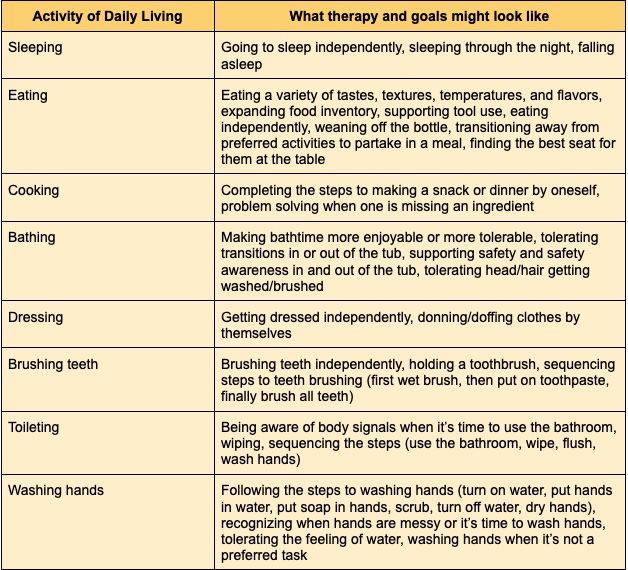
These goals can be through habilitation (teaching skills for the first time), rehabilitation (reteaching the skills after an injury or new medical condition), maintenance (supporting skills or current functions in those with chronic health conditions), or prevention (identifying and reducing risks and risk factors). Services can take place in hospitals, schools, clinics, skilled nursing facilities, health care facilities, or in the home. Many occupational therapy goals involve parent or caregiver training, therapeutic strategies, and environmental modifications to support goals of function.
What can pediatric occupational therapy support?
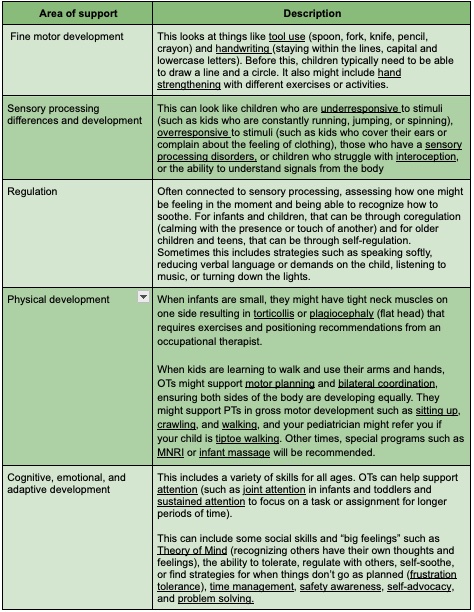
For children specifically, occupational therapy includes areas such as their daily routines, school readiness, and fine motor skills. These skills developed during play and daily routines are critical in learning how to learn and supporting a strong foundation for later skill acquisition. For children, their main “occupation” is play!
There are many areas and subareas occupational therapists can support, including:
What is Assistive Technology (AT)?
Sometimes strategies and environmental modifications are not enough. Assistive technology (AT) is
something OTs can implement to increase access or success in a certain area. Assistive technology
can be large (such as wheelchairs) or small (such as grips on a pencil). They can be high-tech (such
as a communication device) or low-tech (such as a shower chair).
They can be for a variety of reasons:
– mobility (wheelchairs, certain types of orthotics or braces),
– activities of daily living (adapted tools),
– assistive listening (hearing aids, integrated listening systems)
– use of computers and computer modifications (keyguards)
– positioning (such as padded or structured seating to support low tone or weak core strength,
squishy seats to give kids more input, helping them sit and attend longer)
– vision supports (such as glasses, enlarged font, visual indicators such as a circle for circle
time or a piece of tape to mark where to stand in line)
– memory or organization aids (post-it notes, planner, calendar reminders)
– sensory supports (swings, chewie, weighted vest or blanket, compression vest)
– safety measures (bed rails, standers)
– modified toys (switch-activated)
For more information on AOTA, check out The American Academy of Occupational Therapy’s event
page and their “What is OT?” page. Once again, thank you to all the occupational therapists and
assistants that help children and adults get back to their activities of daily living.